Advice for your Climb
With proper planning climbing the Zugspitze, even for inexperienced climbers, is a fantastic adventure. However, attempting this climb without the adequate equipment is extremely dangerous. If, after taking the virtual tour, you would like to climb the Zugspitze for yourself, here are some useful tips.
Route profile
The challenging route to the top of Zugspitze takes you through several different aspects of this particular mountain. With a total elevation change of 8,202 ft and a distance of 6.5 miles a healthy level of fitness is recommended.
Experienced climbers can conquer the entirety of Zugspitze. Many climbers, however, underestimate the requirements of the total distance and altitude change. Generally this climb requires two days with an overnight stay in the Höllentalangerhütte. This allows those wishing to reach the summit a chance to rest safely and gather their strength again.
Ascent via the Höllental
Duration about 8 h
Distance 6.5 mi
Elevation Gain 8,200 ft
Via ferrata Category C
Key Points of Interest
The upper section of the route are for experienced hikers with excellent stamina and sure footing. Safe handling of the via ferrata, ice crampons, and possible hiking or trekking poles is required.
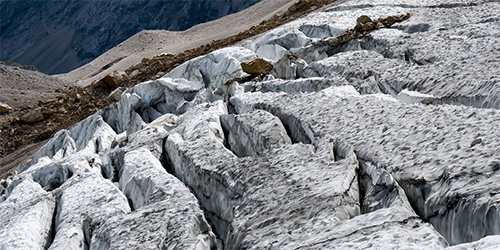
Höllentalferner and Randkluft
The conditions at the glacier are constantly changing, especially depending on the season and the current weather. The nature of the ice itself can be cumbersome and dangerous. Crossing without ice crampons is inadvisable at best. When nearing the Randkluft it is best to follow the tracks of other climbers, and to pay close attention to the crevasses. Stopping to store your ice crampons at the Randkluft can be dangerous, stay aware of yourself and your surroundings.
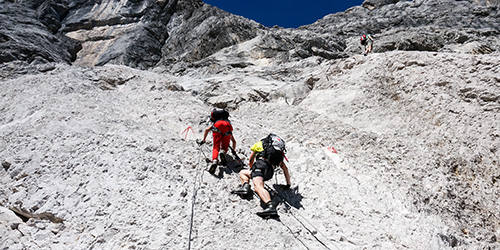
Via ferrata to the Summit
The path to the summit itself is a moderate climb, and is rated in the B/C categories. The route is very well developed, but still quite steep. Ensure that you are safe and stable at all times, especially when attempting to capture a photo of the view. Sudden changes in weather can occur, and it is best to be prepared for any and all weather.
Preparation
Personal Assessment
The difficulty of this climb can vary from season to season. It is important that each climber assesses their own strengths and knows what is too much for them:
- Making sure that you understand the route, and that you know the key points of interest.
- The weather can change, and the current conditions may vary across the climb. Make sure you have alternative routes planned.
- Take time for breaks. Know how long it will take you to reach an area before nightfall. Know the travel times of the cabel cars and the railway. Notify friends and family that you are going climbing, and when you are expected to return.
- Make sure that you, and any other members of your group, are healthy and fit for the challenging climb.
- That you have all of the necessary equipment and that is all in working order.
More information can be found in the DAV‑booklet "Sicher auf die Zugspitze" (Safe up the Zugspitze)
Equipment
To complete this climb safely make sure that you have all of the proper equipment. Only bring what is necessary. Do not over-burden yourself with unnecessary items as it can cause you to tire out before reaching your destination.
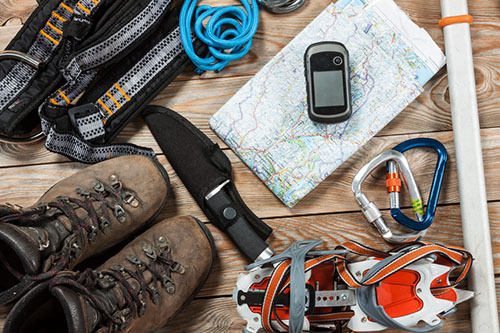
- Via feratta set, climbing harness and helmet
- Hiking boots
- Ice crampons
- Protective gloves
- If necessary, hiking poles or ice axes
Best season
The Höllental is accessible only during the snow-free season. As a reminder, at this altitude the snow accumulates until the summer. Our suggestion is to go during the late summer.
Huts on the route
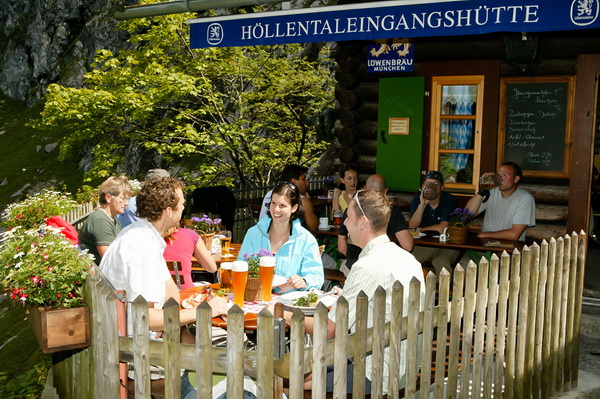
Höllentaleingangshütte
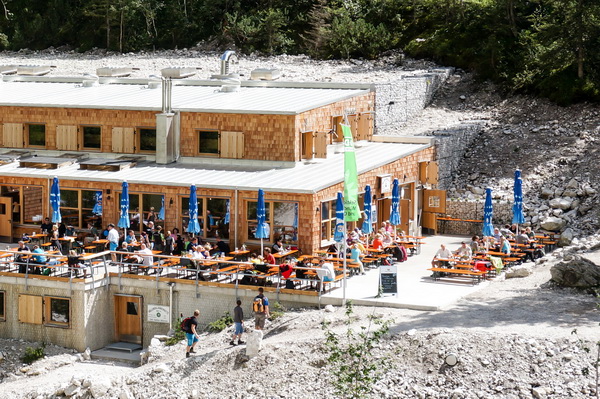
Höllentalangerhütte
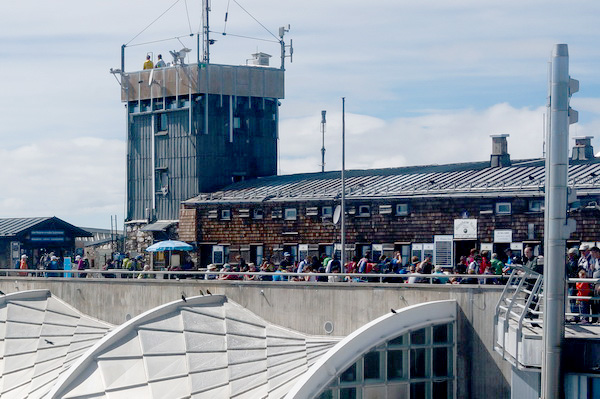
Münchner Haus & Top Station
The lodges, or huts, generally provide meals to hikers, climbers, and tourists alike. The rebuilt Höllentalangerhütte and Münchner Haus also offer accommodations for multi-day tours. However, their avaliablity depends on the weather, but are generally open from May until October.
At the summit of Zugspitze next to the Münchner Haus is the top station of the Eibsee cable car and access to the Zugspitzplatt and railway. Both of these run up and down the mountain daily, generally until 4:30pm. The overnight accommodations in the Muenchner Haus are slim on the weekends. Those who do not need to stay in the mountain should pay close attention to the final trips provided by the Eibsee cable car or the railway for the day.
Höllentaleingangshütte Höllentalangerhütte Münchner Haus Timetable Zugspitzbahnen
Approach
The way to Hammersbach is easy to find. Entering the place of departure directions to the destination are provided. Once in Hammersbach the trail parking lot is located in the Höllentalstraße.
From the North: A95 Munich - Garmisch. At the end of the autobahn proceed via Oberau to Garmisch and after the tunnel turn right towards Reutte. In Garmisch continue towards Grainau. After leaving the town and before arriving in Grainau turn left to Hammersbach and follow the signs Höllentalklamm. Located on the right side, the trail parking lot of Höllentalstraße.
Surroundings
Zugspitze is not the only exciting or interesting place to visit while in the area. Don't forget to visit some of the other places in the surrounding.
Grainau & Eibsee
The town situated at the base of Zugspitze, Grainau, is not just a place to stop and stay before you begin your adventure up Zugspitze. This town has several unique places all on it's own. One of these is the Eibsee, with crystal clear water, it's a wonderful place to swim or go on a boating tour. If you, instead, prefer to travel by bicycle there are several cycling and mountain biking trails throughout the foothills of the mountain. The steep mountains also provide excellent conditions for paragliding.
Adjacent region
Colorful paintings adorn the town houses of the Zugspitze region that stretches around Grainau and Germany's highest mountain. Throughout the year, guests can experience traditions and customs first hand at numerous festivals and get to know culture and history on forays. For instance Mittenwald is known since the Middle Ages as center for violin makers. Oberammergau is since the plague year 1633 inseparably connected with the Passion - the suffering of Jesus, which the citizens bring to stage every ten years. Expressionists are at home in Murnau, since Wassily Kandinsky discovered the city at the Staffelsee in the early 20th century. Music lovers flock to Richard Strauss Institute in Garmisch-Partenkirchen, where the composer was once inspired for his Alpine Symphony. Also shaped was the region by Bavarian King Ludwig II. He gave the assignment to erect Linderhof Palace in the Ammergau Alps and to build his King's House on Schachen in Reintal.